Pigment Red 177 Technical Data: Heat Resistance, Light Fastness, and Chemical Stability
Pigment Red 177 is a high-performance organic red pigment widely considered for applications where excellent durability, color stability, and resistance to demanding processing conditions are required. For manufacturers of coatings, plastics, masterbatch, printing inks, and industrial products, understanding the technical properties of Pigment Red 177 is essential when selecting a suitable pigment grade.
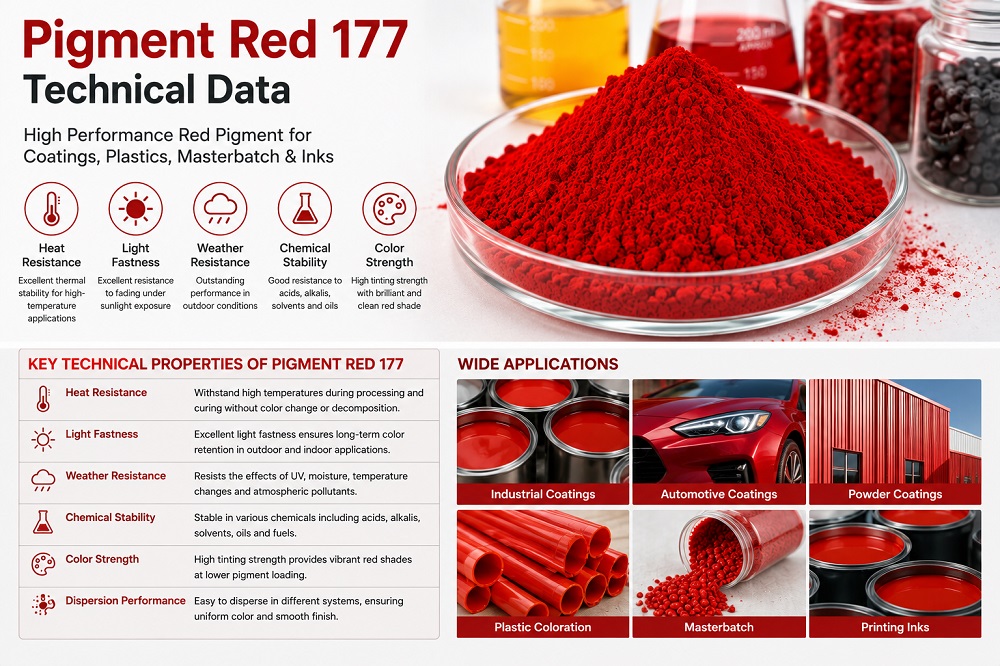
Among the most important characteristics of Sắc tố màu đỏ 177 are its heat resistance, light fastness, weather resistance, chemical stability, and color strength. These properties make C.I. Pigment Red 177 a valuable option for applications where conventional red pigments may not provide sufficient long-term performance.
This guide explains the key technical characteristics of Pigment Red 177 and discusses how heat resistance, light fastness, chemical resistance, dispersion, and color performance influence different industrial applications.
What Is Pigment Red 177?
Pigment Red 177, commonly abbreviated as PR177, is an organic red pigment belonging to the anthraquinone pigment family. It is recognized by the Colour Index designation C.I. Pigment Red 177 and is generally associated with a clean bluish-red shade.
PR177 is considered a high-performance pigment because it provides a combination of color strength and durability that makes it suitable for demanding applications.
Basic Characteristics of Pigment Red 177
- C.I. Pigment Red 177
- Anthraquinone organic pigment
- Bluish-red shade
- High-performance pigment
- Excellent light fastness
- Strong heat resistance
- Good weather resistance
- Good chemical stability
- Suitable for coatings and plastics
- Suitable for selected masterbatch and ink applications
Exact technical values can vary between commercial grades and manufacturers. Buyers should always request the current Technical Data Sheet and Certificate of Analysis for the specific Pigment Red 177 grade being considered.
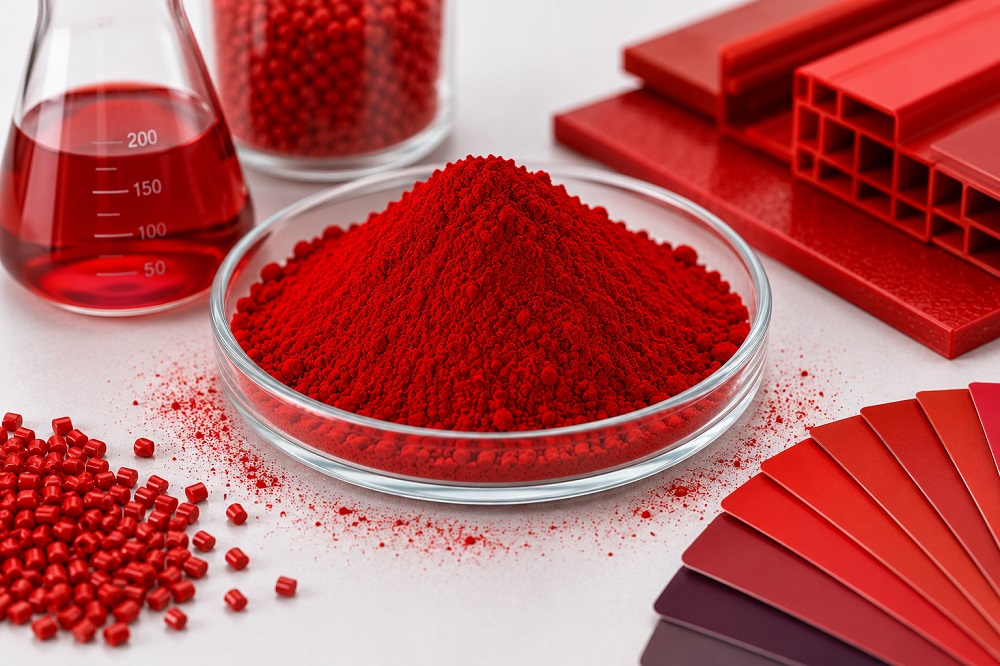
Pigment Red 177 Heat Resistance
Heat resistance is one of the most important properties of Pigment Red 177, particularly for plastic coloration, masterbatch, powder coatings, and other applications involving elevated processing temperatures.
During plastic processing, pigments may be exposed to high temperatures for a specific period of time. If a pigment has insufficient thermal stability, the final product may experience color changes, reduced color strength, or other processing problems.
Why Heat Resistance Matters
Plastic processing methods such as injection molding, extrusion, blow molding, and compounding can involve significant heat. Powder coatings also require elevated curing temperatures.
A thermally stable pigment helps maintain the desired color during processing and reduces the risk of unwanted shade changes.
Pigment Red 177 for High-Temperature Plastics
Pigment Red 177 can be considered for high-temperature plastic applications because of its strong thermal stability. It may be suitable for engineering plastics and other polymer systems where processing temperatures are relatively high.
However, actual performance should always be evaluated under the specific processing conditions of the final formulation.
Pigment Red 177 for Powder Coatings
Powder coating manufacturers need pigments that can withstand curing conditions without significant color degradation.
The strong heat resistance of PR177 makes it a useful candidate for selected powder coating formulations, especially when combined with the required outdoor durability and color stability.
Pigment Red 177 Light Fastness
Light fastness describes the ability of a pigment to resist fading or color change when exposed to light, particularly ultraviolet radiation.
For outdoor coatings, automotive finishes, plastic components, and other products exposed to sunlight, excellent light fastness is an important performance requirement.
Excellent Resistance to Fading
Pigment Red 177 is recognized for its excellent light fastness. This allows products colored with suitable PR177 grades to maintain their red appearance for extended periods when exposed to appropriate environmental conditions.
Importance for Outdoor Products
Outdoor products can be exposed to sunlight continuously throughout their service life. Poor light fastness can result in gradual fading and visible changes in color.
Using a high-performance pigment such as Pigment Red 177 can help manufacturers develop products with improved long-term color retention.
Light Fastness Depends on the Complete Formulation
Pigment performance should not be evaluated independently from the rest of the formulation. Resin type, pigment concentration, additives, film thickness, surface properties, and environmental exposure can all influence the final result.
For this reason, manufacturers should conduct light fastness testing using the actual coating or plastic formulation whenever possible.
Pigment Red 177 Weather Resistance
Weather resistance is related to a pigment's ability to maintain performance when exposed to outdoor environmental conditions such as sunlight, moisture, temperature changes, and atmospheric pollutants.
Pigment Red 177 provides strong weather durability and can therefore be considered for demanding outdoor applications.
Automotive Applications
Automotive coatings and plastic components may remain exposed to sunlight, rain, humidity, road contaminants, and temperature fluctuations for many years.
The excellent light and weather resistance of PR177 makes it an attractive pigment for selected automotive applications.
Industrial Equipment
Industrial machinery, agricultural equipment, construction equipment, and outdoor metal products can also require durable red coloration.
Pigment Red 177 can provide stable coloration in appropriately formulated industrial coating systems.
Outdoor Plastic Products
Plastic products used outdoors require pigments that can resist fading and environmental degradation. PR177 can be considered for outdoor plastic components where long-term color stability is important.
Pigment Red 177 Chemical Stability
Chemical stability is another important characteristic for industrial pigments. Finished products may come into contact with oils, solvents, fuels, cleaning agents, acids, alkalis, or other chemicals depending on their application.
Pigment Red 177 provides good chemical resistance and is suitable for applications where the pigment needs to maintain stable coloration in challenging environments.
Resistance to Solvents
Coatings and inks may contain or come into contact with organic solvents. Pigment stability is important for maintaining color performance and preventing unwanted interactions within the formulation.
Resistance to Oils and Fuels
Automotive and industrial products may be exposed to oils, lubricants, fuels, and other petroleum-based substances. A stable pigment can help maintain the appearance of the finished product.
Resistance to Cleaning Chemicals
Industrial equipment and consumer products may be cleaned using detergents or other chemical agents. Pigment Red 177 can be considered for applications requiring good resistance to common chemical exposure.
Pigment Red 177 Color Strength
Color strength is an important economic and technical parameter for pigment manufacturers and downstream users. A pigment with strong tinting strength can achieve the required color intensity at an efficient concentration.
High Tinting Strength
Pigment Red 177 provides strong color performance and can be used to produce clean and attractive red shades in suitable coating and plastic formulations.
Influence of Dispersion
Color strength is closely related to pigment dispersion. Even a high-strength pigment may perform poorly if it is not properly dispersed in the coating, polymer, or ink system.
Manufacturers should therefore optimize dispersion conditions and evaluate the pigment in the actual production formulation.
Pigment Red 177 Dispersion Performance
Good pigment dispersion is essential for achieving uniform coloration and consistent product quality.
During production, pigment particles need to be distributed evenly throughout the selected resin, polymer, solvent, or carrier system.
Why Dispersion Matters
- Improves color uniformity
- Helps achieve consistent color strength
- Reduces color streaks
- Improves surface appearance
- Supports stable production
- Helps optimize pigment usage
Factors Affecting Pigment Dispersion
Dispersion can be affected by particle size, particle distribution, surface characteristics, resin compatibility, additives, mixing equipment, shear force, temperature, and processing time.
For this reason, manufacturers should evaluate the actual pigment grade within their own formulation rather than relying only on general pigment specifications.
Pigment Red 177 Particle Characteristics
Particle characteristics can influence pigment dispersion, color strength, transparency, opacity, gloss, and overall appearance.
Particle Size
Particle size can influence the optical properties and processing behavior of an organic pigment. The optimal particle characteristics depend on the intended application.
Particle Distribution
A consistent particle distribution can contribute to predictable dispersion and color performance during production.
Surface Characteristics
The surface characteristics of pigment particles can affect their interaction with polymers, resins, solvents, and dispersing agents.
Pigment Red 177 for Coatings
Pigment Red 177 is well suited to a range of high-performance coating applications where long-term color durability is important.
Automotive Coatings
PR177 can be used in selected automotive coating systems because of its excellent light fastness, weather resistance, and color stability.
Industrial Coatings
Industrial equipment and machinery coatings often require resistance to sunlight, chemicals, abrasion, and environmental exposure. Pigment Red 177 can provide durable red coloration for suitable formulations.
Powder Coatings
Its strong thermal stability makes PR177 a candidate for powder coating systems that require high-temperature resistance during curing.
Architectural Coatings
For selected architectural and decorative applications, PR177 can provide a durable red shade with good outdoor color retention.
Pigment Red 177 for Plastics
Plastic manufacturers often select high-performance pigments when the final product must withstand elevated processing temperatures and long-term environmental exposure.
Engineering Plastics
Engineering plastics can require high-temperature processing and excellent long-term color stability. Pigment Red 177 can be considered for compatible engineering polymer systems.
Automotive Plastics
Automotive plastic components may require high heat resistance, light fastness, weather resistance, and chemical stability. PR177 can meet many of these requirements in suitable formulations.
Masterbatch
Masterbatch manufacturers require strong color strength, good dispersion, thermal stability, and batch-to-batch consistency. Pigment Red 177 can be used in suitable high-performance red masterbatch formulations.
Pigment Red 177 for Printing Inks
Pigment Red 177 can also be considered for selected printing ink applications where durable red coloration and resistance to environmental conditions are important.
Solvent-Based Inks
For solvent-based systems, manufacturers should evaluate pigment compatibility, dispersion, solvent resistance, and final color performance.
Industrial Printing
Industrial printing applications may require pigments that maintain color strength and stability during processing and long-term use.
Color Consistency
Consistent pigment quality is particularly important for large-scale printing operations where color matching must remain stable across multiple production batches.
Technical Data Buyers Should Request
Before purchasing Pigment Red 177, buyers should request detailed technical information from the supplier.
Technical Data Sheet
The TDS should provide information about the product's typical properties, recommended applications, color characteristics, and relevant technical performance.
Safety Data Sheet
The SDS provides information related to safe handling, storage, transportation, and emergency procedures.
Certificate of Analysis
A COA can help buyers verify the quality characteristics of an individual production batch.
Application Test Data
For demanding applications, additional application test data can be useful for understanding pigment performance in coatings, plastics, masterbatch, or other systems.
How to Evaluate Pigment Red 177 Technical Performance
Technical specifications provide useful information, but laboratory testing is the best way to determine whether a particular pigment grade meets the requirements of a specific application.
Color Shade Test
Compare the pigment with an approved reference standard under controlled conditions.
Tinting Strength Test
Measure relative color strength to determine whether the pigment provides the required intensity at the target concentration.
Heat Stability Test
Process the pigment under the actual temperature and residence time expected during production.
Light Fastness Test
Expose the finished formulation to a controlled light source and evaluate any resulting color change.
Weathering Test
For outdoor applications, accelerated weathering tests can provide additional information about long-term color stability.
Chemical Resistance Test
Expose the finished coating or plastic formulation to relevant chemicals and evaluate changes in color, surface appearance, or other properties.
Why Pigment Red 177 Is Considered a High-Performance Red Pigment
The main advantage of Pigment Red 177 is not a single technical property but the combination of multiple performance characteristics.
Its heat resistance supports high-temperature processing. Its excellent light fastness helps reduce fading. Its weather resistance supports outdoor applications, while its chemical stability makes it suitable for demanding industrial environments.
Balanced Performance
A pigment that performs well across several durability categories can provide greater formulation flexibility for manufacturers.
Long-Term Color Stability
Stable color performance can improve the service life and appearance of finished products.
Wide Application Potential
The performance characteristics of PR177 make it suitable for multiple industries, including coatings, plastics, masterbatch, automotive products, and selected printing ink applications.
How to Select the Right Pigment Red 177 Grade
When purchasing Pigment Red 177, buyers should not assume that every product with the same Colour Index designation will perform identically.
Define the Application
Determine whether the pigment will be used for coatings, plastics, masterbatch, inks, or another application.
Define the Processing Conditions
Identify processing temperatures, curing conditions, mixing conditions, and expected exposure to chemicals or environmental factors.
Define the Color Target
Specify the required red shade, tinting strength, transparency, opacity, and other optical characteristics.
Request Samples
Obtain samples from potential suppliers and evaluate them using the actual production formulation whenever possible.
Compare Technical Data
Review TDS, SDS, COA, and other available technical documents before making a final purchasing decision.
Why Consistent Pigment Quality Is Important
Even a high-performance pigment can create production problems if quality varies significantly between batches.
For industrial manufacturers, consistent color strength, shade, particle characteristics, and dispersion performance help reduce formulation adjustments and production waste.
Stable Color Production
Consistent pigment quality helps manufacturers maintain the same color standard across multiple production batches.
Reduced Production Adjustments
Stable pigment properties can reduce the need for repeated formulation corrections during production.
Reliable Finished Product Quality
Consistent raw materials contribute to more predictable performance and appearance in finished products.
How to Choose a Pigment Red 177 Supplier
Technical performance is only one part of supplier selection. International buyers should also evaluate manufacturing capability, quality control, technical support, documentation, production capacity, and delivery reliability.
Manufacturing Experience
An experienced pigment manufacturer should understand pigment chemistry, particle control, dispersion, and application requirements.
Quality Control System
Strict quality control procedures help maintain consistent product characteristics from one production batch to another.
Technical Support
A professional supplier should be able to provide application recommendations and technical assistance when required.
Stable Supply Capacity
Reliable production capacity is important for customers that use Pigment Red 177 continuously in commercial manufacturing.
Conclusion
Pigment Red 177 is a high-performance organic red pigment with a strong combination of heat resistance, excellent light fastness, weather resistance, chemical stability, and color strength. These properties make it suitable for demanding applications in coatings, plastics, masterbatch, automotive products, powder coatings, and selected printing inks.
When evaluating Pigment Red 177, manufacturers should consider more than a single technical specification. Heat resistance, light fastness, chemical stability, dispersion, color strength, weather resistance, and application compatibility should all be evaluated according to the requirements of the final product.
For international buyers, selecting a reliable Pigment Red 177 manufacturer is equally important. A supplier that can provide consistent quality, complete technical documentation, application support, and stable supply can help manufacturers achieve reliable production and long-term product performance.
Before large-scale purchasing, it is recommended to test the selected Pigment Red 177 grade under actual production conditions and compare its performance with the required technical standards. This approach allows manufacturers to select the most suitable pigment grade for their specific application while maintaining consistent quality and cost efficiency.
những sản phẩm liên quan
 Pigment Red 177 vs Pigment Red 170: Which Organic Red Pigment Should You Choose?
- What Is Pigment Red 177? Properties, Applications, and Benefits Explained
- Why Pigment Red 177 Is Ideal for Plastic Coloration and Masterbatch Manufacturing
- Pigment Yellow 97: Properties, Applications, and Technical Guide
- Pigment Blue 60: Properties, Applications, and Buying Guide for Industrial Buyers
- Pigment Yellow 139: Properties, Applications, and Buying Guide for Industrial Buyers
- Pigment Red 177 for Industrial Coatings: Why It Is the Preferred High-Performance Red Pigment
- Pigment Red 177 Buying Guide: Everything Importers Need to Know Before Purchasing
- Pigment Red 146: Properties, Applications, and Technical Guide
- Pigment Yellow 110: Properties, Applications, and Buying Guide for Industrial Manufacturers