What Is Pigment Red 146 and Where Is It Used?
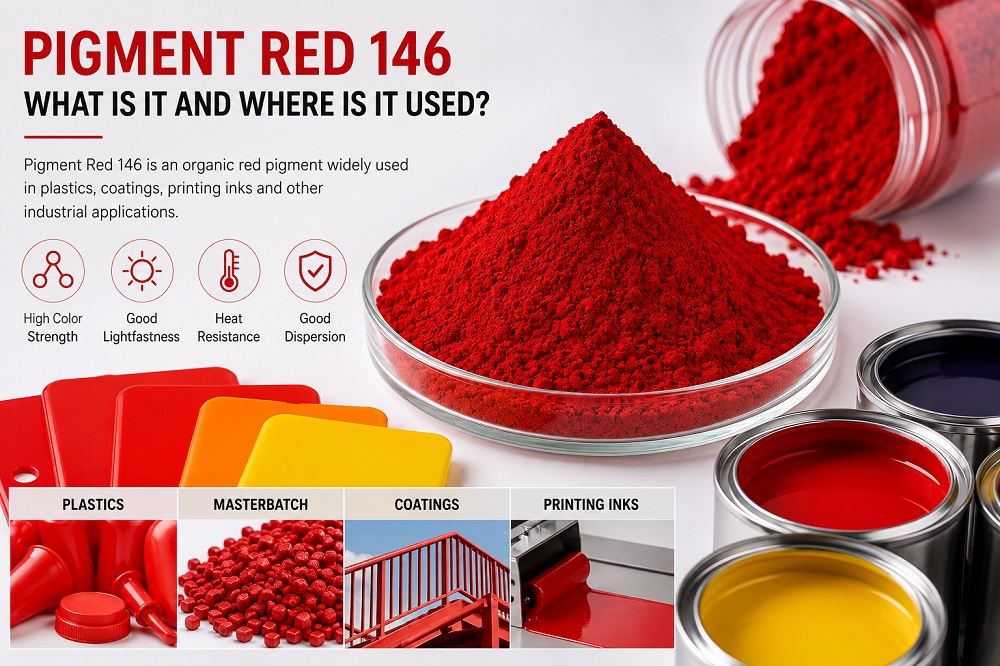
Pigment Red 146 is a synthetic organic red pigment widely used in industrial coloring applications. It is commonly considered for plastics, masterbatch, coatings, printing inks, and other products that require a stable and attractive red color.
For pigment manufacturers, plastic processors, coating producers, ink manufacturers, and industrial buyers, understanding the properties and application requirements of Pigment Red 146 can help in selecting the right grade for a specific formulation.
What Is Pigment Red 146?
Sắc tố màu đỏ 146 is an organic pigment belonging to the azo pigment family. Unlike dyes, pigments are generally insoluble in the medium in which they are used. Instead, pigment particles are dispersed throughout a polymer, coating, ink, or other material to produce the required color.
Commercial Pigment Red 146 products may differ in particle characteristics, purity, finishing treatment, dispersion behavior, and other technical properties. Therefore, the performance of a specific grade should always be evaluated according to its technical data and intended application.
Why Is Pigment Red 146 Used?
Red coloration is required in many industrial products, from plastic components and packaging to coatings and printing materials. Pigment Red 146 offers manufacturers a practical organic pigment option when a strong red shade and suitable processing performance are required.
Key Properties of Pigment Red 146
The performance of Pigment Red 146 depends on the specific grade and manufacturing process. Important properties to evaluate include color strength, dispersion, heat resistance, lightfastness, chemical resistance, and compatibility with the formulation.
Color Strength
Color strength determines how efficiently a pigment develops color in a formulation. A pigment with good coloring strength can help manufacturers achieve the desired red shade at an appropriate pigment concentration.
Final color performance can also be influenced by pigment concentration, particle characteristics, polymer or resin type, and processing conditions.
Dispersion
Good dispersion is essential for achieving uniform coloration. Properly dispersed Pigment Red 146 can help reduce color variation and pigment agglomeration while improving the appearance of the finished product.
Dispersion performance depends on the pigment grade, formulation, mixing equipment, carrier system, and processing method.
Chịu nhiệt
Heat resistance is especially important in plastic processing. Extrusion, injection molding, and other manufacturing processes can expose pigments to elevated temperatures for different periods of time.
The selected Pigment Red 146 grade should therefore be compatible with the thermal conditions of the intended polymer system.
Lightfastness
Lightfastness describes a pigment's ability to retain its color when exposed to light. It becomes particularly important for outdoor products and materials exposed to sunlight.
Because performance can vary between commercial grades, buyers should check the supplier's technical specifications when long-term color durability is required.
Chemical Resistance
Pigment performance can be affected by solvents, acids, alkalis, plasticizers, additives, and other formulation components. Chemical resistance should therefore be evaluated according to the intended application and exposure conditions.
Where Is Pigment Red 146 Used?
Pigment Red 146 can be used in several industrial coloring systems. Common application areas include plastics, masterbatch, coatings, and printing inks.
Plastics and Masterbatch
In plastics, Pigment Red 146 can be incorporated into thermoplastic materials to produce red-colored products. Applications may include molded components, packaging, household products, consumer goods, profiles, and containers.
It can also be used in color masterbatch, where the pigment is concentrated in a compatible polymer carrier before being added to the final plastic formulation.
For these applications, manufacturers should primarily evaluate polymer compatibility, processing temperature, dispersion, pigment concentration, migration requirements, and the desired color shade.
Coatings
Pigment Red 146 can be incorporated into selected industrial and decorative coating formulations. The appropriate grade depends on factors such as resin compatibility, solvent environment, color requirements, light exposure, and weathering conditions.
Printing Inks
Suitable Pigment Red 146 grades can also be used in selected printing ink systems. Important formulation considerations include dispersion, color strength, transparency, viscosity, printing method, and substrate compatibility.
Factors That Affect Pigment Red 146 Performance
The same pigment can perform differently in different formulations. Understanding the factors that influence performance is therefore important for product developers and pigment buyers.
Pigment Particle Characteristics
Particle size and distribution can influence color strength, dispersion, transparency, and the visual appearance of the final product.
Formulation Compatibility
The interaction between Pigment Red 146 and polymers, resins, solvents, plasticizers, additives, and other formulation components can affect overall performance.
Processing Conditions
Temperature, mixing intensity, residence time, shear conditions, and processing equipment can all influence pigment dispersion and color development.
How to Choose the Right Pigment Red 146 Grade
Selecting a suitable grade should start with the requirements of the finished product rather than the pigment name alone.
Define the Application
Determine whether the pigment will be used in plastics, masterbatch, coatings, printing inks, or another system. This establishes the basic performance requirements.
Set the Color Target
Define the required red shade, tinting strength, transparency, opacity, and acceptable color variation before selecting a grade.
Evaluate Durability Requirements
Consider heat exposure, light exposure, chemical contact, weathering, and other environmental conditions that the final product will encounter.
Test the Pigment in the Actual Formulation
Laboratory testing is recommended before commercial production. Testing the pigment in the customer's actual formulation provides a more reliable indication of dispersion, color development, processing stability, and final performance.
How to Choose a Pigment Red 146 Supplier
For companies purchasing Pigment Red 146 regularly, supplier selection is an important part of maintaining consistent production.
Product Consistency
Batch-to-batch consistency is essential for industrial applications. Variations in shade, color strength, dispersion, or physical properties can affect finished-product quality.
Production Capacity
Large-volume buyers should evaluate whether the manufacturer has sufficient production capacity to support regular orders and long-term supply requirements.
Technical Support
A knowledgeable supplier can help customers select suitable grades based on their polymer, resin, ink, coating, processing, and performance requirements.
Technical Documentation
International buyers may require technical data sheets, safety documentation, compliance information, specifications, and other product documents. These should be confirmed before purchasing.
Packaging and Logistics
For international bulk orders, packaging, transportation, lead time, and supply planning should also be considered when evaluating a Pigment Red 146 manufacturer.
Pigment Red 146 for Bulk Industrial Supply
Industrial customers often purchase Pigment Red 146 in bulk for continuous production. Direct cooperation with an experienced pigment manufacturer can provide benefits in supply planning, technical communication, product consistency, and application support.
When requesting a quotation, buyers should provide information such as application, polymer or resin system, target color, estimated quantity, packaging requirements, processing conditions, and destination market.
Why Request a Sample?
A sample allows customers to evaluate Pigment Red 146 under their own production conditions before committing to a large order.
Testing can be used to compare color shade, tinting strength, dispersion, thermal performance, and compatibility with the customer's existing formulation.
Pigment Red 146 vs Other Red Pigments
Different organic and inorganic red pigments provide different combinations of color, durability, processing performance, and cost. Pigment Red 146 should therefore be compared with alternatives according to the actual requirements of the finished product.
Color Performance
Compare hue, shade, tinting strength, transparency, and opacity to determine which pigment provides the required visual result.
Durability
Heat resistance, lightfastness, chemical resistance, migration behavior, and weathering performance may need to be compared depending on the application.
Total Cost Performance
The most economical pigment is not necessarily the one with the lowest price per kilogram. Pigment loading, coloring strength, processing efficiency, and finished-product quality should all be considered when evaluating overall cost.
Frequently Asked Questions About Pigment Red 146
What is Pigment Red 146?
Pigment Red 146 is a synthetic organic red pigment from the azo pigment family. It is used in various industrial coloring systems, including plastics, masterbatch, coatings, and printing inks.
What is Pigment Red 146 used for?
Pigment Red 146 is used to produce red coloration in plastics, masterbatch, coatings, printing inks, and other industrial products.
Is Pigment Red 146 suitable for plastics?
Suitable grades can be used in plastic applications. Polymer compatibility, processing temperature, dispersion, and color requirements should be evaluated before production.
Can Pigment Red 146 be used in masterbatch?
Yes. It can be incorporated into masterbatch systems when the pigment provides suitable dispersion and compatibility with the selected carrier resin.
Can Pigment Red 146 be used in coatings and printing inks?
Yes. Suitable grades can be used in selected coating and printing ink formulations. The appropriate grade depends on the formulation, processing conditions, and required performance.
How do I choose a Pigment Red 146 manufacturer?
Consider product consistency, production capacity, technical support, documentation, quality management, packaging, delivery capability, and experience with international customers.
Can I buy Pigment Red 146 in bulk?
Yes. Pigment Red 146 is available for industrial bulk purchasing. Buyers should provide their application, quantity, technical requirements, and packaging preferences when requesting a quotation.
Looking for a Reliable Pigment Red 146 Supplier?
If you are sourcing Pigment Red 146 for plastics, masterbatch, coatings, printing inks, or other industrial applications, choosing the right supplier can make a significant difference in product consistency and production efficiency.
Our Pigment Red 146 solutions are designed for industrial customers who need reliable color performance, consistent quality, and stable bulk supply. Whether you are testing a new pigment, replacing an existing supplier, or planning regular production orders, we can help you evaluate the most suitable grade for your application.
Request a Pigment Red 146 Sample
Send us your application requirements and we can provide a Pigment Red 146 sample for testing. Application information such as polymer or resin type, target color, processing temperature, and required performance can help us recommend a suitable grade.
Get Technical Data and a Bulk Quote
For commercial purchasing, you can request technical specifications, product documentation, packaging information, and a competitive quotation based on your required quantity.
Contact us today to discuss your Pigment Red 146 requirements, request a sample, or get a quotation for bulk orders.
Conclusion
Pigment Red 146 is a versatile organic red pigment used in plastics, masterbatch, coatings, printing inks, and other industrial coloring applications. Its suitability for a particular product depends on factors such as color strength, dispersion, heat resistance, lightfastness, chemical resistance, formulation compatibility, and processing conditions.
For manufacturers and international buyers, selecting the right Pigment Red 146 grade should involve technical evaluation and application testing rather than relying solely on price or color appearance. A reliable Pigment Red 146 manufacturer can provide product documentation, samples, technical support, consistent quality, and stable bulk supply to support long-term production.
những sản phẩm liên quan
 Pigment Yellow 97: Properties, Applications, and Technical Guide
- Why Pigment Red 177 Is Ideal for Plastic Coloration and Masterbatch Manufacturing
- Pigment Red 177 Buying Guide: Everything Importers Need to Know Before Purchasing
- Why Global Buyers Prefer Pigment Red 177 for High-Performance Industrial Products
- What Is Pigment Red 177? Properties, Applications, and Benefits Explained
- Pigment Red 177 Technical Data: Heat Resistance, Light Fastness, and Chemical Stability
- Pigment Red 177 vs Pigment Red 170: Which Organic Red Pigment Should You Choose?
- How to Choose the Right Pigment Yellow 97 for Plastics, Coatings, and Inks
- Pigment Red 177 for Industrial Coatings: Why It Is the Preferred High-Performance Red Pigment
- Pigment Red 146: Properties, Applications, and Technical Guide